

By Telis Demos
Oct. 11, 2024
Hurricane Milton has taken a heavy toll on families, property and businesses. But in the complex insurance market, the effects aren’t so straightforward.
As estimates of likely insured losses begin to firm up, the range of possible outcomes for the insurance industry is also narrowing. At this early stage, preliminary estimates of Milton’s insured damages suggest that a relatively larger proportion of the losses will be borne by reinsurers, and less so by primary insurers. These levels likely wouldn’t result in big losses for catastrophe bonds, which are specialized investments that typically bear the risk of loss when extreme events occur.
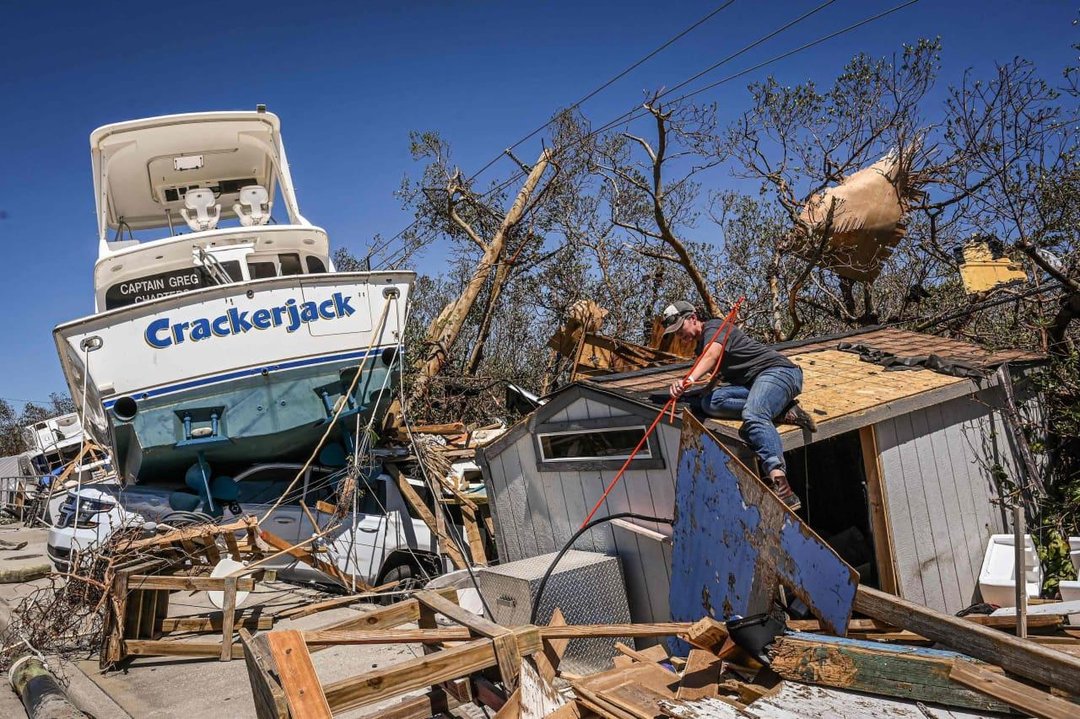
A person clearing debris after Hurricane Ian in Fort Myers Beach, Fla., in 2022. Photo: Giorgio Viera/AFP/Getty Images
Fitch Ratings estimates that Milton’s insured losses will range from $30 billion to $50 billion, which would make it significantly more costly than Hurricane Helene, but wouldn’t rise to the level of Hurricane Ian in 2022. The Insurance Information Institute estimates Ian’s inflation-adjusted insurance losses at over $55 billion.
Reinsurance has become more expensive in the past couple of years, driven in part by the impact of Hurricane Ian, as well as the sharp jump in interest rates since then, which reduced the amount of investment capital pouring into the sector, at least for a while. Some recent reinsurance has also come with higher attachment points, or the loss level at which coverage kicks in.
As a result, primary insurers have at times been relatively more exposed to losses from events such as hail and severe thunderstorms, which are individually less severe than a hurricane but whose increasing frequency can add up to sizable insurance losses.
“Considering that there was no one single major [catastrophe] loss event in the quarter, and accounting for the firming of reinsurance terms and conditions starting in 2023, including higher attachments, we expect [catastrophe] losses to be far more weighted to primary carriers,” said a note from Jefferies analyst Yaron Kinar this week, referring to soon-to-be-reported third-quarter results.
But primary insurers still typically have significant reinsurance cover for more extreme events, such as giant storms and earthquakes, or coverage specific to a region such as Florida. At Milton’s projected scale, according to Fitch, reinsurance attachment points will be met, shifting a meaningful amount of the losses to reinsurance.
“Any industry loss event that is $10 billion or less would largely be retained by primary insurance companies,” says Neuberger Berman global insurance analyst Chai Gohil. “And as events go from $10B onwards, more and more is retained by reinsurance companies.”
Since the start of 2022, reinsurance stocks in the S&P Composite 1500 had well outperformed property-and-casualty stocks in that index through the beginning of the Atlantic hurricane season this year in June. But that gap has narrowed since then.
For reinsurers, the fact that the development of Milton’s path and strength over the course of this week appears to have avoided the worst-case scenarios has been a relief. Reinsurance stocks had their worst day since 2020 on Monday, but have pared back much of those losses over the course of this week. In general, the recent improvement in pricing and profitability has given the reinsurance industry a sizable cushion.
S&P Global Ratings estimates that the reinsurance industry has a buffer of $64 billion before catastrophe losses affect its capital. “Global reinsurers will feel the impact but we do not foresee Milton overstepping the sector’s annual catastrophe budgets,” S&P wrote this week.
Catastrophe bonds designed to cover some of the most extreme risks have also recently seen strong returns despite covering more remote risks. Florian Steiger, chief executive of Icosa Investments, which focuses on alternative fixed-income investments, says that “most cat bonds really shouldn’t start taking losses at events below $50 billion.”
Going forward, though, reinsurance stocks might have a higher bar to keep significantly outperforming their primary peers.
Analysts and investors will be looking closely at what expected losses from Milton are disclosed, to better benchmark the industry’s new pricing and terms versus losses from past events. “It would stand to reason that if 2022’s Hurricane Ian occurred today, it would result in a better return profile for reinsurers,” says Jefferies’ Kinar.
Industry losses being short of a worst-case scenario might make it harder for reinsurers to push through another big jump in pricing during policy renewals at the start of next year. An industry loss of around $40 billion might not be favorable to shares of Bermuda-based reinsurers, as it could drive some hits to earnings but “without offering much pricing support,” according to Autonomous Research analyst Ryan Tunis.
Whether the cost of reinsurance pricing continues to rise is also a pocketbook issue for many homeowners. A study by professors now at the University of Pennsylvania’s Wharton School and the University of Wisconsin School of Business estimated that the recent “reinsurance shock” added $375 in 2023 to premiums for homeowners’ policies in the top 10% of zip codes by disaster risk.
If reinsurance pricing remains steady, it means consumers probably won’t see much relief in their premiums. But an industry that proves it is better able to absorb a disaster of this scale without another big adjustment at least means things won’t get significantly worse.
Write to Telis Demos at Telis.Demos@wsj.com
Dow Jones & Company, Inc.