

By Tom Vanderbilt
April 25, 2025
London holds many memories for me, postcards from past selves. When I first visited in my 20s, I was an aspiring writer cadging invites to Blacks Club, a members-only spot in Soho. In my 30s, I saw my romantic relationship crash at a Chelsea soccer match and, a decade later, I failed the notoriously tough U.K. driver’s exam on assignment, an embarrassment that still stings. Now, in my 50s, I was taking my teenage daughter—whose own memories of visiting the city as a younger child were fading—on her spring break to see it in a new, less tourist-thronged way. The Wall Street Journal set me a challenge: to find a more under-the-radar London on a budget of $1,000 over three days, despite the flagging dollar ($1 equals .75 GBP) and a teenager in tow.
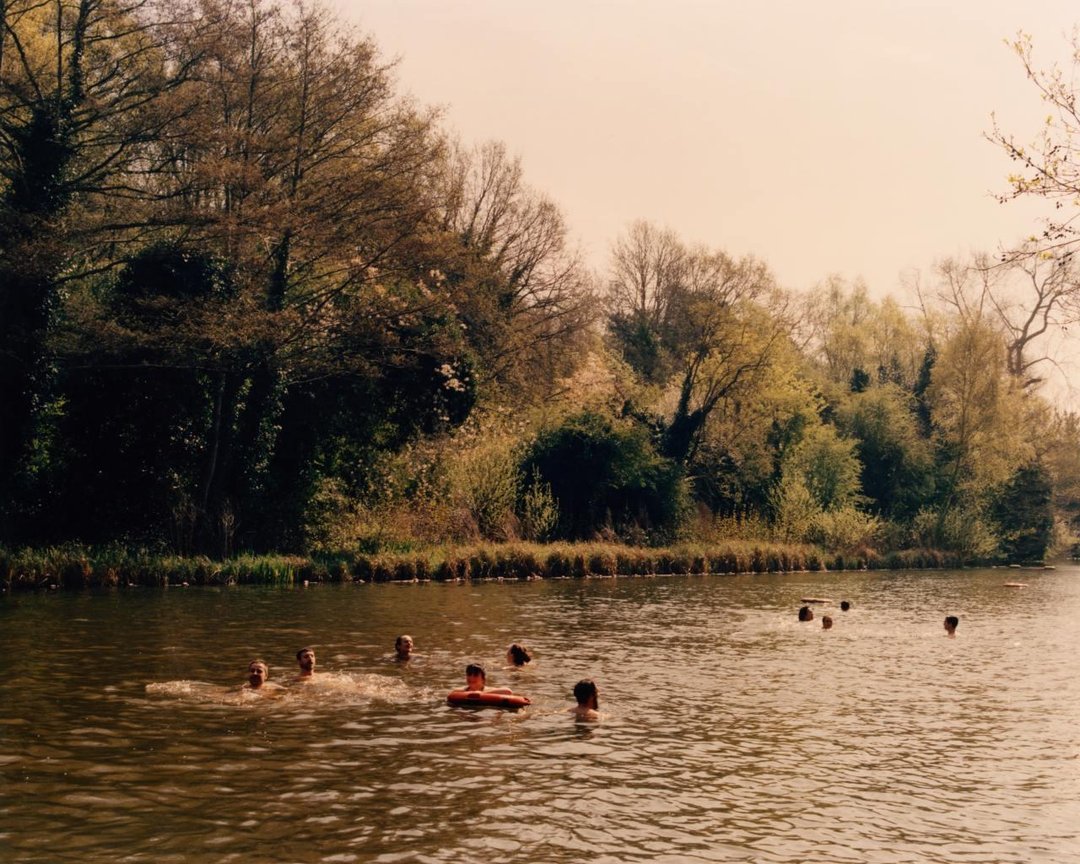
Travelers are welcome to join the ‘wild swimming’ fun in the pond at Hampstead Heath. Photo: Sandra Mickiewicz for WSJ
In the land of the stiff upper lip—keep calm and travel on—I accepted the challenge.
Day One | $1,000 remaining
No five-star digs for us. I wanted a quiet, conveniently located spot with pleasing decor, so chose a “wellness” hotel called Inhabit Southwick Street ($185 a night, breakfast included), a short walk from Paddington Station. That meant we could forgo an airport taxi and book tickets on the Heathrow Express app to get to town. Cost: $28. We liked Inhabit’s calming blend of Scandinavian and Japanese design—like sleeping in a Muji store, which I mean in the nicest way.
To get some air and shake off travel, we took the tube north ($7.30) to Hampstead Heath, a sprawling preserve of ancient forests and royal hunting grounds known for its “wild swimming” ponds—one for men, one for women, one “mixed.” Once I paid the $6 fee for the mixed pool, I plunged into the bracing 53-degree water. My daughter got literal cold feet, opting to lie on a nearby bank in the unseasonable sun. You haven’t really lived until you’ve paddled through a springtime pond lined by trees and reeds, its surface flecked with flower petals, as the life of the city unfolds around you. At one point, two ducks suddenly scampered into the water, pursued, unsuccessfully, by a fox.
A half-hour’s ramble from the ponds took us to Kenwood House, the hilltop villa that architect Robert Adam designed for the first Earl of Mansfield in the late 18th century. I noted that the 1999 rom-com, “Notting Hill,” starring Julia Roberts, was filmed partly at Kenwood—but my daughter seemed unmoved, lingering by the Rembrandts and Vermeers.
Visiting Kenwood House, like most historic homes and museums in London, costs nothing. Next, we traipsed to the also-free Hill Garden and Pergola, spying no human life save for a bridal shower on the lawn, its participants in fancy dresses. Otherwise, we were contentedly alone—and famished.
That is when we splurged on a taxi ($25), my daughter choosing the cab’s rear-facing seat, as we headed to Tollington’s, an Iberian-inflected seafood restaurant in a former fish and chips shop in Finsbury Park. There we scarfed sole, sardines, bifana (Portuguese pork sandwiches) and, just trust me, delicious potato-skin ice cream (total: $85).
Well-fortified, we took the tube south to Matrade Loftus Road Stadium, the 18,000-seat home of the Queens Park Rangers, a football club that competes in the division below the Premier League. For two second-row seats behind the goal in the family section, we paid $25, well worth the chance to cheer and badger the players, along with the boisterous crowd, as the home team Hoops battled to a 1-1 draw against Bristol City.
The hour walk back to our hotel was a delightful tramp through Ladbroke Grove, Notting Hill and Bayswater. Jet lag caught up with us and we collapsed for the night.
Day Two | $630 remaining
My daughter finds history fascinating, so I used that focus as a guide. (Another factor: our dwindling cash flow.) The Imperial War Museum in Southwark has few rivals, bringing the London Blitz and other global conflicts to life.
I geeked out on its exhibit about Molotov cocktails the Finns made at a vodka distillery to attack Russians in the Winter War; my daughter was taken by haunting tales of children sent out of England and across the globe, ahead of hostilities.
Afterward, we crossed London Bridge and caught, at my daughter’s urging, the 147 bus ($4.60) heading north. More than just public transport, London’s red double-deckers deliver an experience, albeit with no tour guide bantering away. Ours was filled with people going about their day.
We jumped off near Bethnal Green and made our way to Arnold Circus, a stunning place often used in fashion photo shoots. Nearby, at Rochelle Canteen, our indulgent ($92) lunch included a verdant salad topped with Sutton Hoo Chicken (a free-range brand), and spinach soup with a poached egg floating on top. Afterward, strolling down Brick Lane, we stopped at Dark Sugars, a shop where my daughter cajoled me into buying the Dubai chocolate bar, a viral sensation in 2024.
We then headed north to fashionable Stoke Newington, once a stronghold of dissenters against the Church of England. Twee shops line Church Street, and nearby Abney Park is an eerie arboretum, one of London’s “Magnificent Seven” cemeteries. To bring the day full circle, we lingered over the graves of fallen British soldiers.
Day Three | $290 remaining
Our instructions were simple: Meet at the obelisk beneath the Millennium Bridge. There, on our final day, we found Vanessa Bunton, a historian and “mudlark.” While the term originally connoted people who trawled the Thames’ embankment for salable refuse, today, it means those licensed to scour the shoreline for historical objects.
What initially felt underwhelming became fascinating when Bunton explained how the flotsam in this urban archaeological site reveals how people, from Romans to Victorians, lived. Things heated up when Bunton told us about the time she found human remains and had to spend three hours at the police station (2-hour Thames Explorer Trust tour, $33).
From there we took a 20-minute stroll through Fleet Street to Sir John Soane’s Museum in Holborn. Made up of three houses that Soane, an architect, demolished and then rebuilt, this small, bewitching masterwork holds some 50,000 objects, including the sarcophagus of the Egyptian Pharaoh, Seti I, carved in alabaster and emphatically etched with hieroglyphics. Anyone can “visit” it online in a virtual 3-D tour of the Sepulchral Chamber, where it sits atop fluted stone columns.
Lest anyone think I’d taken my long-suffering daughter on an endless field trip of cultural enrichment—though, yeah!—I often happily indulged her interests. We stopped for bubble tea at a HeyTea, traipsed to Borough Market for strawberries and chocolate (sadly, someone forgot to check what days it was open) and popped into vintage and thrift shops. I’ve learned that your child’s memory of a trip isn’t always what you hoped it would be: On a trip to Mexico back when she was nine, my daughter had considered a burger at the airport the highlight of a painstakingly planned itinerary.
And we did our share of wandering and window shopping. From Holborn, we walked down Lamb’s Conduit Street into Bloomsbury, popping in at Present & Correct, a shop founded by former graphic designers, that sold new and vintage stationery.
We eventually got to the Wallace Collection, an art museum in Marylebone with paintings by Frans Hals and Thomas Gainsborough, and “Delusions of Grandeur,” a show of Grayson Perry’s eccentric work.
I especially wanted to share a longtime favorite, Daunt Books, the travel-themed temple of literature on Marylebone’s High Street. She bought a set of stories with English text on one side, Spanish on the other, $12. We wound up on Chiltern Street—per square foot, one of the world’s most intriguing shopping blocks.
At Niwaki, a Japanese garden supply store, I bought gardening gloves ($16). We poked our heads into British preppy outfitter John Simons (too pricey for this trip) and, around the corner, Labour and Wait, which offers hard-to-summarize housewares you didn’t know you wanted. I was already about $125 over budget, so my wallet stayed put in my back pocket.
Despite my overage, we closed out our London adventure with a greedy feast ($112) at Kricket in Soho, a contemporary Indian restaurant originally launched as a pop-up in a shipping container. We had lots to choose from: delicious grills and curries, tandoor breads and small plates of pakoras, Jerusalem artichoke samosas and Keralan fried chicken.
What to SKIP and Where to SPEND
When you’re navigating a big city like London, meals and travel can eat up a travel allowance, so stay vigilant about where and what to eat. Below, some tips.
SKIP the Ubers/taxis, SPEND on snacks
Cabs are wonderful but fares can exponentially multiply. London rewards walking: Simply pick a neighborhood and wander. We played a walking game, seeing who could first spot the blue plaques on London houses, where historical figures, from HMS Bounty commander William Bligh to Jimi Hendrix, lived. Along the way, stop for a chocolate bar or matcha, maybe one that’s recognizable from a TikTok.
SKIP dinner, SPEND on lunch (or vice versa)
To stay on budget we would limit ourselves to one “nice” meal a day, and look for budget options elsewhere. Luckily, these abound in London and are often what Londoners truly eat. Grab a sandwich at Waitrose and take it to a local park or square, or visit one of the many Nando’s, known for peri-peri chicken and strawberry lemonade. When my daughter recognized the Italian chain Vapiano from a trip we took to Chile, we had dinner at the one near our hotel.
SKIP the tourist draws, SPEND time at museums
Our budget would have been destroyed if we’d gone to costly bucket-list spots like the Tower of London or Westminster Abbey. Instead, head to one of the infinite museums found in the city, most of which are free (though you’re always welcome to make a small donation). Visit the National Gallery and the Courtauld, but don’t forget about the Foundling Museum or the Hunterian Museum. Use the money you saved on admission for a nice tea and cake at the Djanogly Café at Tate Britain.
The Wall Street Journal is not compensated by retailers listed in its articles as outlets for products. Listed retailers frequently are not the sole retail outlets.
This Wall Street Journal article was legally licensed by AdvisorStream.
Dow Jones & Company, Inc.