

By Sharon Terlep
June 8, 2026
Timothy Mason drives a pair of Honda Accords: One is a 2010 model with fewer than 40,000 miles that he uses for his daily commute in Massachusetts to his accounting job, the other a 2001 V-6 with more than 280,000 miles he uses for tough winter driving.
“Where’s the financial sense in a new car?” Mason, 41, says. “Better fuel mileage, maybe, but is it going to save me $800 plus per month?”
Mason is on the extreme side of something happening across the country: America’s cars are older than ever.
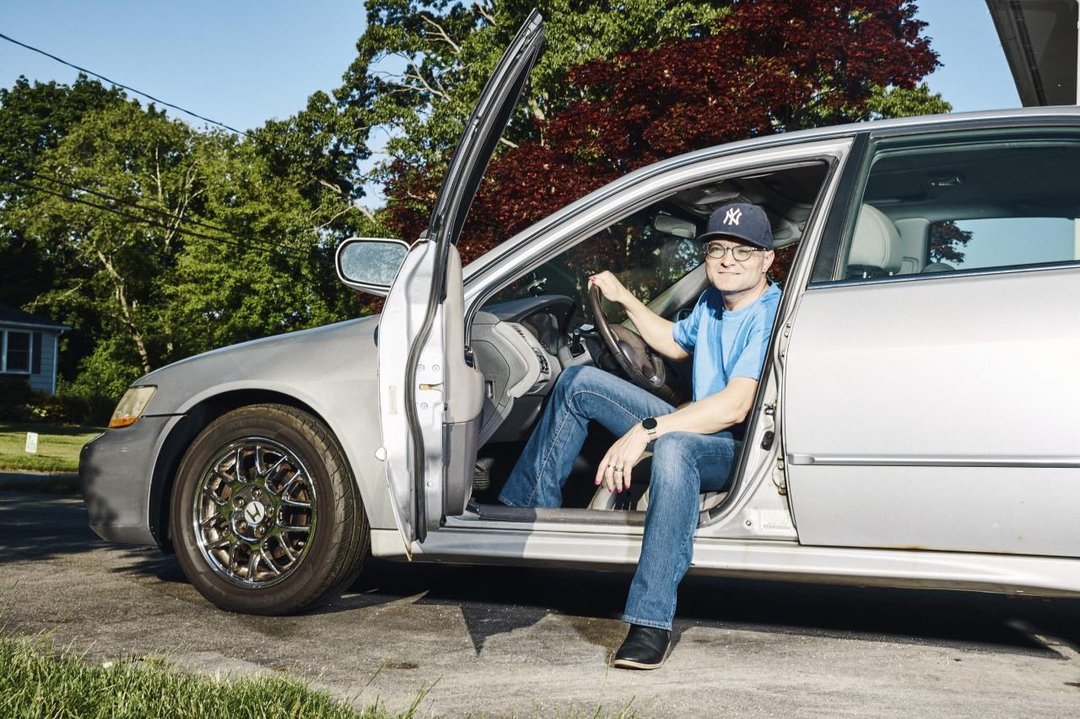
Timothy Mason drives a 2001 Honda Accord. Simon Simard for WSJ
Some drivers are squeezing more miles out of their vehicles and eschewing new rides because of sticker shock, high interest rates and economic jitters. Others are hanging on to aging wheels simply because they can. Thanks to advancements in engineering, materials and safety technology, today’s cars last longer than vehicles of generations past.
The average vehicle on U.S. roads is about 13 years old, a historic high and a 10% jump from a decade ago.
While cars have steadily grown older over the last 15 years, the trend picked up after the Covid pandemic, when shuttered factories and supply-chain snarls drove up prices. The shift has accelerated in recent years as more car buyers balk at lofty new-vehicle prices, and many automakers grapple with fallout from America’s cooling on electric vehicles, which has cost companies tens of billions in lost investments and forced them to rethink their U.S. lineups.
The reality is fundamentally reshaping the economics of buying, selling and fixing vehicles in America.
Automakers, long laser-focused on the new-car market, are now pouring resources into propping up used-car sales, aftermarket parts and maintenance work. Dealers are investing in their repair shops, adding service bays and a phalanx of customer-friendly services once reserved for luxury patrons. All the while, competition for repair work is mounting among mom-and-pop mechanics, big oil-change shops and tire chains vying for a piece of the fix-it business.
“If we’re not going to make money on the selling side, we have to make it on the service side,” said Ed Roberts, operating chief of Bozard Ford Lincoln in St. Augustine, Fla. “And everybody is fighting for a piece of that pie.”
Wall Street used to gauge the auto industry’s health by how many new cars drove off dealer lots. Automakers this year expect to sell about 16 million new cars to Americans. But increasingly, the big money is in keeping the existing fleet alive.
“There’s never been a more competitive landscape” for vehicle service, said Skyler Chadwick, a consultant with auto industry data firm Cox Automotive.
Partly, that’s because flagging U.S. new-car sales show no imminent sign of rebounding. Even used-car sales are relatively flat, simply because there aren’t enough of them to meet demand. The Covid-triggered supply-chain crisis of a few years ago prevented automakers from making enough cars to meet demand.
Tom Sparks is watching the miles creep up on the cars he and his wife drive, a 2010 Honda CR-V and a 2014 Toyota Avalon. He’s a retired pastor, and she’s a retired schoolteacher; together they have ample income to afford a new car. They just aren’t interested.
Sparks is considering a new CR-V, but the $40,000 price tag for the one that comes with the right features is more than he wants to spend. The cost is actually lower than the average price of a new vehicle, which now hovers around $50,000, according to Kelley Blue Book. But that’s around $10,000 more than at the start of the decade, according to the same data.
Cars continue to get more expensive; the average selling price in April jumped 1.8% from a year earlier. Elevated interest rates make new-car purchases even pricier.
“There’s just a big lack of choice between $30,000 and $40,000,” Sparks said.
A few years ago, the difference might not have mattered, but with everything from home repairs to car insurance rising in cost, it’s too much, he said, adding: “Shopping for a car is one of my least favorite activities.”
Chadwick, the Cox Automotive consultant, said, “Consumers are really handcuffed to their current vehicles and they have no choice sometimes but to repair their vehicle.”
Ford Motor is hoping to reap benefits from this change in perspective—and the company’s own aging fleet.
Usually, when the company launches an ad campaign, it’s to sell a new model or tout a deal. Its latest marketing effort: convincing people to get their Fords fixed at the company’s dealerships.
“There is the perception that dealer service is not competitive,” said Daniel Justo, vice president of Ford’s customer service division. The company is trying to change that.
The company this week rolled out ads touting mobile service, where roving technicians, equipped with special service vans, travel to wherever customers are and perform diagnostics, maintenance and some repairs on site.
Ford also is beefing up its use of connected data to steer owners to its dealers. Vehicles, when they encounter mechanical problems such as faulty wiring or an air leak, can now beam that information to the owners app and to the dealer. The information allows the dealer’s service shop to get parts ahead of time rather than waiting for the car to be diagnosed on location.
Automakers benefit when people are willing to pay more for used models, because vehicles with high resale value can command higher prices when they’re sold new. GM and other automakers are working to grow sales of parts that are used for repairs and to soup up and customize cars.
The certified preowned business—where manufacturers offer warranties, extensive repairs and other assurances on used vehicles—is also booming well beyond its luxury-car roots. Automakers from Hyundai to GM are beefing up their certified used-car programs, covering cars for longer.
“There’s an old saying in the car business: ‘You sell them once in the sales department, you sell them 10 times over in the aftersales part of our business,’ ” John Roth, president of General Motors’ Cadillac brand, said at an investor conference last year.
Independent repair shops have proliferated rapidly in recent years, and they’re stealing customers from dealers—even before a car’s warranty is up.
At dealerships around the country, perks are on the rise for customers who seek assistance in keeping their older vehicles running. It’s a shift for an industry that has been notoriously slow in adapting to a culture of customer convenience.
Traditionally, dealers are known for long waits, opaque pricing and inflexible hours. Now, companies like Penske Automotive Group, one of the nation’s largest dealership chains, are racing to win more repair and maintenance work with perks like work centers equipped with Wi-Fi and copy machines, free cappuccino and service visits that get completed in an hour. “It’s just a really nice place to go if you need your car serviced,” said Penske finance chief Shelley Hulgrave.
Penske is also adding bays and service capacity, even if it means shrinking showrooms. “Each technician, each bay is very profitable for us,” said Hulgrave.
She expects demand for repairs to continue to rise. Already, the average age of vehicles that come into Penske dealerships has begun to tick up; cars that are even a few years old need more repair and maintenance than new vehicles.
For dealers, fixing cars is orders of magnitude more profitable than selling them. The service business now comprises around half of the average dealer franchise’s gross profit, according to Cox.
But dealers’ share of service visits fell by 12% since 2018 as customers defect to independent repair shops, according to a Cox study that came out last year and rattled the industry.
Most concerning to dealers: the biggest loss of business came from customers with cars that are two to five years old, vehicles typically under warranty. Dealers used to think of a warranty as locking in a customer.
Service visits are down even to cars two or fewer years old. In the past, defections were expected once a car’s warranty ran out, but now they occur much more quickly.
National oil-change and tire shop chains are also in greater competition with dealers and the independent shops. Jiffy Lube, one of the nation’s biggest oil-change chains, offers some basic repairs and diagnostics and has been rapidly expanding.
None of this surprises Scott Loring, service manager at Pine Hill Automotive, a 50-year-old repair shop in Holbrook, Mass. He described his consumers as largely blue collar, a demographic for whom a new car is increasingly out of reach.
Even if people can afford a new car, he said, they may avoid buying one because they fear that the new technology and connected features will require dealer service.
The age of older cars isn’t distributed evenly across the U.S., according to 2024 data from S&P Global. Cars in Montana are among the oldest in the country at 18 years old on average; in other states, they skew relatively younger, like 11 years old in Texas.
“You get in the higher financial areas and you see the new cars,” said Loring, who drives a 10-year-old Chevrolet Silverado pickup. “Here, they’re trying to keep the older ones on the road.”
Still, everywhere now, drivers like Chris Gleeson—who are in with their cars for the long haul—are becoming the norm.
Gleeson, of St. Joseph, Ill., set out to buy a new car six years ago, but couldn’t find what he wanted amid the pandemic vehicle shortages. Instead, he snapped up a used Toyota Tacoma with 22,000 miles on it.
Today, buying a new car isn’t on his radar. His wife is also keeping her 2007 Toyota Prius. “It’s unkillable,” Gleeson said.
“I can count on one hand the number of repairs I’ve needed and I’ve never been stranded,” said Gleeson, a former software engineer who is now working toward a master’s degree in social work. The next car he buys will likely be an EV. But not anytime soon.
“I hope this will be the last gasoline truck I ever own,” he said. “I plan to keep it for another 15 years.”
This Wall Street Journal article was legally licensed by AdvisorStream.
Dow Jones & Company, Inc.